

A torn coverall seam during a hot work permit job can shut down an entire shift, and in Singapore's industrial sectors, that single failure costs more than just the price of replacement fabric. Safety officers across construction sites, marine yards, and logistics hubs face the same challenge: sourcing sg workwear that survives tropical heat and heavy use without the markup that comes from traditional distributors. RigArmor manufactures cotton industrial coveralls at 11 Woodlands Close, #08-20, Singapore 737853, supplying factory-direct to crews who need gear that actually lasts through the conditions you deal with every day.
What fabric weight is recommended for industrial workwear in Singapore's tropical climate?
Industrial workwear in Singapore should use fabrics between 180-220 GSM (grams per square meter) to balance durability with breathability in tropical heat. Fabrics above 250 GSM trap excessive heat and reduce worker comfort in humidity levels that regularly exceed 80%.
How much does industrial workwear typically cost per worker in Singapore?
Industrial workwear in Singapore costs between SGD 80-150 per worker for a complete set including shirt, pants, and safety boots, with bulk orders of 50+ units reducing per-unit costs by 20-30%. Custom branding adds SGD 8-15 per garment depending on embroidery complexity and logo size.
What sizing system should be used for multi-national industrial crews in Singapore?
Multi-national industrial crews in Singapore require dual sizing systems with both Asian (S-3XL) and Western (EU/US) measurements clearly labeled, as Asian-cut workwear typically runs 1-2 sizes smaller than Western equivalents. Providing a detailed size chart with chest, waist, and inseam measurements in centimeters reduces return rates by up to 40%.
Table of Contents
- Understanding Singapore's Industrial Workwear Landscape
- Fabric Selection for Tropical Industrial Environments
- Sizing and Fit Standards for Multi-National Crews
- Custom Branding Without the Markup
- Procurement Strategy for Safety Officers
- The Real Cost of Industrial Workwear in Singapore
- Making Smart Workwear Decisions for Your Team
- Common Questions About SG Workwear Sourcing
Understanding Singapore's Industrial Workwear Landscape
Singapore's Ministry of Manpower (MOM) requires employers to provide proper protective clothing for workers in hazardous environments, but many companies struggle to find gear that meets both safety standards and budget constraints. The regulations cover everything from high-visibility requirements to flame-resistant materials, depending on your industry. Getting this wrong can lead to workplace accidents, failed inspections, and hefty fines that nobody wants to deal with. What makes it trickier is that sg workwear needs vary wildly between a construction site, a shipping dock, and a warehouse floor.
What MOM Actually Requires
The Workplace Safety and Health Act sets clear rules about protective clothing, but interpreting them for your specific crew can get confusing. Most industrial operations need workwear that protects against specific hazards while keeping workers comfortable in Singapore's humid climate.
- High-visibility clothing for workers near moving vehicles or equipment
- Flame-resistant materials for welding and hot work operations
- Durable fabrics that can withstand daily wear in harsh conditions
- Proper fit across different body sizes to ensure actual protection
Real Problems Industrial Crews Face
Talk to any site manager and they'll tell you the same story. Finding quality sg workwear that doesn't fall apart after a few washes is harder than it should be. Construction teams need coveralls that can handle concrete dust and sharp edges, while marine crews deal with salt water and oil stains.
- Cheap polyester blends trap heat and cause discomfort in tropical weather
- Inconsistent sizing between orders means some workers get gear that doesn't fit
- Colors fade quickly under constant sun exposure on outdoor sites
Logistics companies face their own headaches with warehouse uniforms that need frequent replacement. The cost adds up fast when you're buying through traditional distributors.
Why Industrial Grade Matters
There's a huge difference between the coveralls you see at retail shops and what actually works on industrial sites. Retail workwear looks fine but usually uses thinner fabrics and weaker stitching that can't handle real work conditions. Industrial-grade specifications mean reinforced seams, proper weight cotton, and construction methods that last through hundreds of wash cycles.
| Industry | Primary Hazards | Required Features | Typical Replacement Cycle |
|---|---|---|---|
| Construction | Abrasion, debris, sun | High-vis, durable cotton | 6-9 months |
| Marine | Oil, water, chemicals | Stain-resistant, quick-dry | 8-12 months |
| Logistics | Repetitive movement, heat | Breathable, flexible fit | 4-6 months |
The Distributor Markup Problem
Most sg workwear suppliers operate through multiple layers of distributors, each adding their own profit margin. A coverall that costs $15 to manufacture might reach you at $45 or more after passing through importers, wholesalers, and retailers. This traditional model also forces minimum order quantities that don't make sense when you just need to test quality or outfit a small crew.
- Distributor chains typically add 150-200% to factory costs
- Minimum orders of 50-100 pieces lock you into untested suppliers
- Quality inconsistency between batches with no accountability
Companies like RigArmor cut out these middlemen by selling factory-direct, which is why their 100% cotton coveralls come without the usual markup. You can even order a single piece to check quality before committing to your whole team. For more context on different workwear categories and their uses, check out this guide to types of workwear that breaks down various options available in the market.
Fabric Selection for Tropical Industrial Environments
Most industrial crews in Singapore, Malaysia, and the Philippines work in temperatures that regularly hit 32°C with 80% humidity. The fabric you choose for your team's workwear directly affects their comfort, safety, and how long those uniforms actually last. 100% cotton coveralls outperform synthetic blends in high-heat environments because cotton allows sweat to evaporate naturally instead of trapping it against the skin. When your crew is working near hot machinery or spending hours outdoors, that difference matters more than you might think.
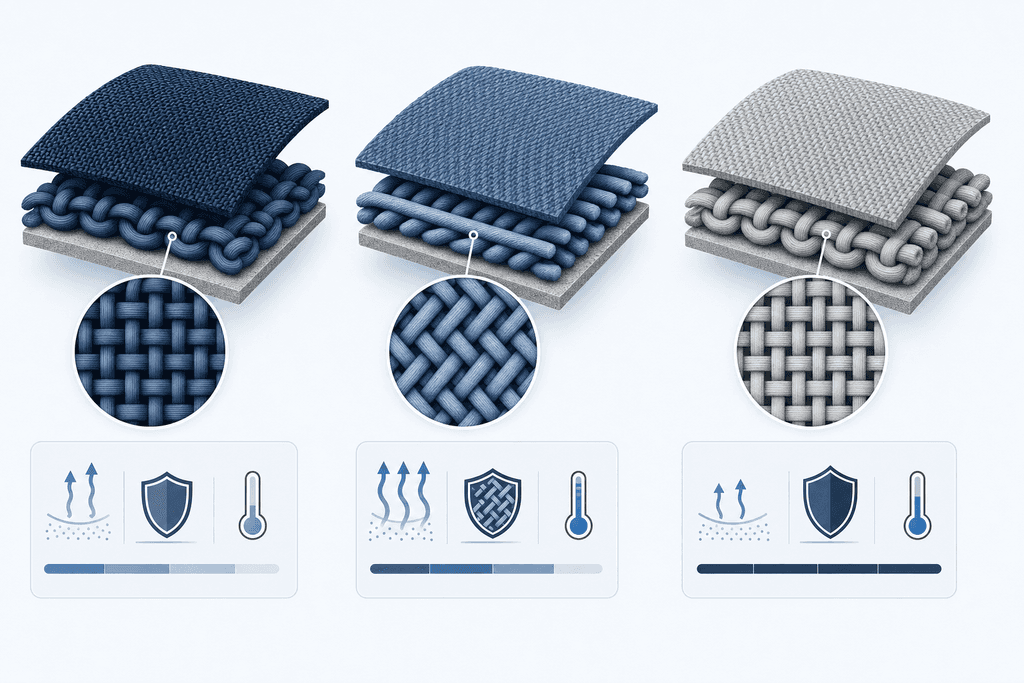
The weight of your sg workwear fabric is measured in GSM, or grams per square meter. A 240 GSM cotton fabric provides solid protection against sparks and abrasions while still breathing well enough for tropical conditions. Lighter fabrics around 180 GSM might feel more comfortable initially, but they wear out faster and offer less protection.
| Fabric Type | Heat Tolerance | Durability | Wash Cycles |
|---|---|---|---|
| 100% Cotton | Excellent | High | 200+ |
| Poly-Cotton Blend | Poor | Medium | 150+ |
| Synthetic | Very Poor | Low | 100+ |
Different job roles need different fabric considerations. Welders and marine crews need heavier cotton that won't melt under heat exposure, while logistics teams might prioritize lighter weight for mobility. The trade-off between breathability and protection isn't one-size-fits-all.
Color fastness becomes critical when you're washing uniforms weekly in tropical conditions. Cheap dyes fade after 20-30 washes, making your branded uniforms look unprofessional. Quality cotton workwear maintains color integrity for 100+ industrial wash cycles, which means your company logo stays visible and your crews look consistent across all sites.
Sizing and Fit Standards for Multi-National Crews
Standard sizing charts from Western manufacturers rarely match the actual body types of Filipino, Singaporean, and Malaysian workers. A "Large" from one supplier might fit like a Medium from another, and that inconsistency creates real problems when you're ordering for 50+ crew members. Industrial workwear sizing needs to be consistent across every single order, not just within one batch. Your team shouldn't have to guess which size to reorder when someone needs a replacement coverall six months later.
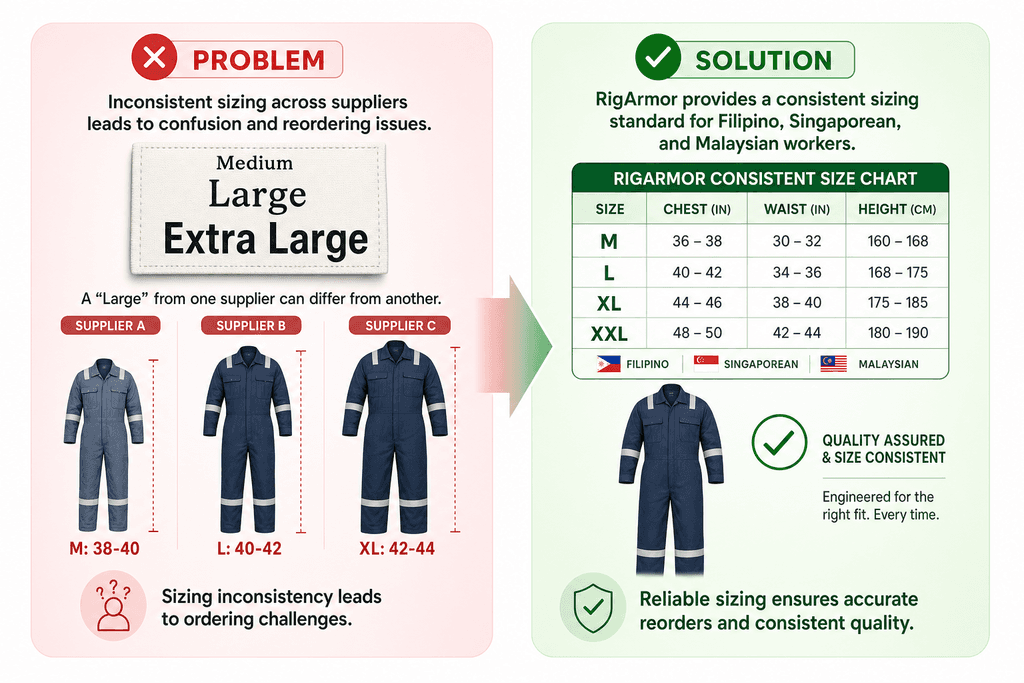
Retail brand sizing uses vanity measurements that don't work in industrial settings. A construction worker needs room to bend, reach, and move without fabric pulling tight across the shoulders or restricting arm movement. RigArmor matches every batch against approved samples to ensure size M today fits exactly like size M in your next order.
- Measure chest circumference at the widest point, not at rest
- Check sleeve length with arms extended, not hanging down
- Account for safety gear worn underneath (harnesses, vests)
- Test range of motion in squatting and reaching positions
- Verify inseam length matches your crew's average height
Size exchanges in bulk orders become expensive fast if you don't get measurements right the first time. Extended sizing from 4XL to 5XL costs the same per unit when you're working with a manufacturer directly, unlike distributors who charge premiums for larger sizes. This matters when you have diverse crews where 15-20% of workers need extended sizing.
The best approach is ordering sample sizes first. One coverall in each size your crew needs lets you verify fit before committing to 100 units. Most safety officers skip this step to save time, then end up with sizing issues that cost more to fix than the sample would have cost.
Custom Branding Without the Markup
Your company logo needs to survive industrial laundering, UV exposure, and daily wear that would destroy regular clothing in weeks. Embroidery lasts 3-5 times longer than heat transfer printing on workwear that gets washed in commercial machines weekly. Heat transfer looks sharp initially but starts peeling after 30-40 wash cycles, while quality embroidery maintains its appearance for the life of the garment. Screen printing falls somewhere in between, working well for large logo areas but vulnerable to cracking on heavy cotton fabrics.
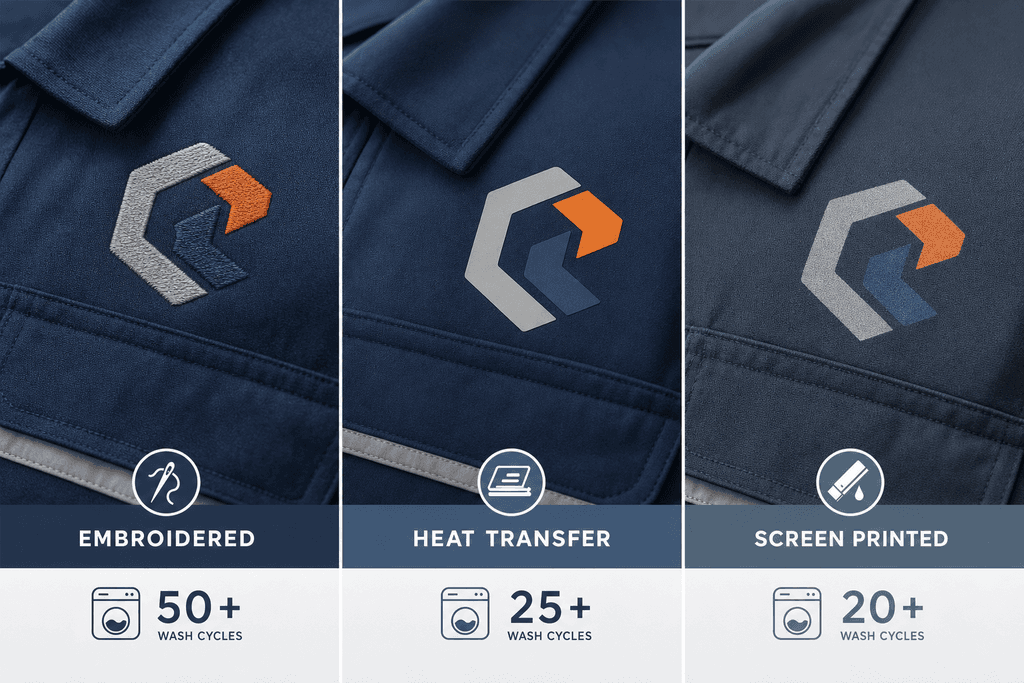
Logo placement affects both visibility and safety compliance. Chest placement works for most industries, but marine crews often need back placement for visibility when workers are facing away. Some safety standards require specific placement zones that don't interfere with reflective striping on high-visibility coveralls.
| Method | Durability | Setup Cost | Best For |
|---|---|---|---|
| Embroidery | 200+ washes | Medium | Small logos, premium look |
| Screen Print | 100+ washes | Low | Large designs, bulk orders |
| Heat Transfer | 40+ washes | Very Low | Complex colors, small runs |
Pantone color matching adds complexity but ensures brand consistency across different fabric batches and production runs. Your safety orange needs to match exactly across 500 coveralls, not vary from batch to batch. Factory-direct sourcing eliminates the 40-60% markup that distributors add for custom branding services.
Minimum order quantities traditionally drive up costs for smaller companies. Working directly with manufacturers like RigArmor removes these barriers since there's no minimum order requirement, even for custom embroidery. You can order 10 branded coveralls instead of being forced into 100-unit minimums.
Procurement Strategy for Safety Officers
Sample orders prevent expensive mistakes that safety officers make when ordering workwear sight unseen. One sample coverall costs less than fixing a bulk order of 50 units that don't fit properly or use fabric that's too heavy for your climate. Testing fabric weight, checking stitching quality, and verifying sizing against your crew's measurements takes 30 minutes but saves weeks of headaches. Most procurement issues come from skipping this step to meet urgent deadlines.
Quality control checkpoints matter when receiving bulk shipments. Check the first five units for consistent sizing, verify logo placement matches your approved sample, and test zipper function before accepting the full order. Stitching should be straight with no loose threads, and fabric color should match across all pieces.
- Verify all sizes ordered are present in correct quantities
- Check logo placement and quality on multiple units
- Test zippers, buttons, and closures for smooth operation
- Inspect seams for consistent stitching and reinforcement
- Confirm fabric weight and color match approved sample
Managing inventory for crew turnover requires planning ahead. Construction sites with 20% annual turnover need buffer stock of common sizes to avoid rush orders when new workers start. Seasonal hiring in logistics means ordering 6-8 weeks before peak periods, not scrambling when temporary crews arrive.
Budget planning across multiple sites gets complicated when each location has different uniform needs. The hidden costs of cheap workwear show up in replacement frequency and safety incidents. A $30 coverall that lasts 6 months costs more than a $45 coverall that lasts 18 months, but procurement departments often focus on initial price rather than cost per wear.
Factory-direct pricing from suppliers like RigArmor removes distributor markups that can add 50-70% to your uniform costs. For a 100-person crew, that difference means $3,000-5,000 in annual savings that can go toward better safety equipment or additional training programs.
The Real Cost of Industrial Workwear in Singapore
Most uniform buyers in Singapore focus on the sticker price when ordering sg workwear, but that number only tells part of the story. The actual cost of keeping your crew properly outfitted includes hidden expenses that pile up over months and years. When you break down where your money goes in a typical workwear purchase, the distribution markup alone can add 40-60% to what you're paying compared to factory-direct pricing. Understanding these cost layers helps you make smarter decisions about your uniform program budget.
Where Your Workwear Budget Actually Goes
Every coverall or uniform piece you buy includes several cost components that most buyers never see itemized. The fabric and manufacturing typically represent only 30-40% of the final price you pay through traditional distributors.
- Raw cotton fabric and materials account for roughly 15-20% of retail price
- Manufacturing labor and production costs add another 15-20%
- Custom branding (embroidery or printing) contributes 5-10%
- Distributor markups and middleman fees inflate the price by 40-60%
- Shipping and logistics add final 5-10% to your invoice
The distributor markup is where things get expensive for uniform buyers. Traditional sg workwear suppliers in Singapore often work through multiple layers of middlemen, each taking their cut before the coveralls reach your crew.
Calculating Total Ownership Costs Beyond the Purchase Price
Smart buyers look at replacement cycles when evaluating workwear investments. A cheaper coverall that wears out in 6 months costs more over two years than a quality piece that lasts 18 months, even if the upfront price is higher.
| Cost Factor | Budget Option | Quality Option |
|---|---|---|
| Initial Price | $35 | $55 |
| Lifespan | 6 months | 18 months |
| 2-Year Cost | $140 | $73 |
The numbers show why choosing the right industrial worker uniforms matters for your bottom line. RigArmor's factory-direct model removes those distributor markups entirely, which is why crews can get 100% cotton coveralls at prices that compete with lower-quality alternatives from traditional suppliers.
How Quality Workwear Impacts Your Actual Operations
The ROI of proper workwear extends beyond just replacement frequency. Workers in comfortable, well-fitting uniforms report fewer heat-related incidents and better mobility on job sites, which directly affects productivity and safety records.
- Proper high-visibility sg workwear reduces accident rates by up to 30% in logistics operations
- Breathable cotton coveralls decrease heat stress complaints by 40-50% compared to synthetic alternatives
- Consistent uniform quality across orders eliminates crew complaints about sizing variations
When you source directly from manufacturers, you also gain control over quality consistency. Every batch gets matched against your approved sample, so your crew gets the same fit and durability every single time you reorder.
Making Smart Workwear Decisions for Your Team
Getting the right sg workwear for your industrial crew comes down to three main things: fabric that works in tropical heat, sizing that fits your actual workers, and pricing that doesn't wreck your budget. Cotton coveralls handle Singapore's humidity better than synthetic blends because they let skin breathe, which matters when your team works 10-hour shifts outdoors. The sizing part trips up a lot of buyers who order standard sizes and then find out half their crew needs 3XL or bigger.
Testing a sample before you commit to 50 units saves you from expensive mistakes. Most traditional sg workwear suppliers force minimum orders of 20 or 30 pieces, which means you're stuck if the fit is wrong or the fabric feels cheap. RigArmor lets you order a single coverall to check the quality and sizing before you place a bigger order, which is how it should work when you're spending company money.
Factory-direct pricing cuts out the markup that distributors add, usually around 30 to 40 percent. That difference adds up fast when you're outfitting a crew of 25 workers or replacing worn-out uniforms twice a year. The key is finding a supplier who can match quality across repeat orders, because nothing looks worse than having your team in coveralls that don't match.
Your next step is simple: figure out your actual size breakdown, test one sample in your most common size, and compare the total cost against what you're paying now. Most safety officers find they can upgrade to better fabric and still spend less overall.
Common Questions About SG Workwear Sourcing
Most uniform buyers in Singapore run into the same roadblocks when sourcing industrial workwear. The questions usually center around quality testing, sizing problems across different batches, and whether suppliers actually care about smaller operations. Here's what safety officers and procurement teams ask us most often about sg workwear specifications and ordering.
What GSM rating works best for Singapore's heat?
For Singapore's climate, a GSM rating between 240-280 gives you the sweet spot between durability and breathability. Anything heavier than 300 GSM turns into a sweatbox for outdoor crews, while lighter fabrics under 220 GSM won't hold up to industrial work. Our 100% cotton coveralls sit at 260 GSM, which handles the heat without falling apart after a few wash cycles.
Can I test one coverall before committing to bulk?
Yes, and you should always do this before placing large orders. RigArmor has no minimum order policy, so you can buy a single coverall to check the fit, fabric weight, and stitching quality. Most distributors force you into bulk purchases right away, which is why so many companies end up with closets full of workwear that doesn't fit their crew properly.
How do you keep sizes consistent across repeat orders?
We match every new batch against your approved sample before shipping. This means if your crew wears 2XL coveralls in March, the 2XL you order in September will have the same measurements. Inconsistent sizing is one of the biggest complaints we hear about other sg workwear suppliers, especially when companies switch between different distributors.
What are typical lead times for custom branded workwear?
Custom logo embroidery or printing usually adds 2-3 weeks to production time after artwork approval. Rush orders can sometimes be accommodated depending on quantity and current production schedules. The key is getting your logo files ready in vector format, which speeds up the setup process significantly.
Do you work with small crews or just big companies?
We supply to both. Small marine crews with 5-10 workers order from us just as easily as large construction operations with hundreds of staff. Factory-direct pricing means you're not paying distributor markups regardless of order size, which levels the playing field for smaller operations.
What's actually included in factory direct pricing?
Factory-direct means you're paying manufacturing cost plus a single margin, not the stacked markups that happen when workwear passes through multiple distributors. You typically save 30-40% compared to buying through traditional uniform suppliers in Singapore. The price includes the garment, quality control, and direct shipping to your location in the Philippines, Singapore, or Malaysia.
